
Designed to close Singapore’s existing container terminals and place them all under one, highly automated roof, Tuas is in for a total transformation. The forward-thinking plan is tailor-made to the 21st century demands of global trade, and redefines efficiency, sustainability and resilience of maritime activity. Completed by region through the 2040s, Tuas will be the world’s biggest fully automated port, servicing up to 65 million twenty-foot equivalent units (TEUs) a year. Its mammoth size, brought about by the most sophisticated technology, makes it a crucial cog in Asia’s fast-expanding logistics chain.
A Bold Move with Global Impact

It was a big move to consolidate the operations from Tanjong Pagar, Keppel, Brani and Pasir Panjang into Tuas. These terminals, are also long-standing key nodes in the Singapore shipping system. But the ever-growing size of container ships, the complexity of trade flows that have to find ways of being loaded and unloaded efficiently, made the logic of a single mega hub that much more compelling.
By consolidating operations, the Tuas network overcomes fragmentation and forms a singular, centralised network that can meet the demands of global shipping at a scale and with a speed never before seen. Spread over more than 1,300 hectares of reclaimed land, or thousands of football fields, it provides Singapore with the physical capacity to handle trade volumes for a long time to come. This bold initiative will further enhance Singapore’s maritime competitiveness and it will ensure that Singapore will continue to be the maritime hub premised on global shipping.
Technology and Automation a Key Factor
What sets Tuas Mega Port apart is its size and its embrace of cutting-edge technologies that are rethinking how ports work. Automation is key with driverless vehicles moving containers across huge yards, and quay and yard cranes being managed remotely for accuracy and safety. These machines work 24 hours a day, eliminating mistakes made by humans and vastly increasing productivity. But beyond the physical automation, at Tuas there is also a version of the port called a digital twin that enables operators to run simulations, predict disruptions and optimize real-time decisions.
Berth planning and just in time vessel scheduling programs are reducing congestion with data driven systems and blockchain backed documentation is making trade easier. 5G technology connectivity enables the exchange of information seamlessly between machines and systems, reaffirming Singapore’s commitment to spearhead the digital revolution in global logistics.
Commitment to Sustainability
Sustainability alongside innovation With technological progress there is also a strong commitment to sustainability at Tuas Mega Port, in Singapore. The port is the first of its kind and is said to slash carbon emissions by using electrified equipment, clean energy-powered automated guided vehicles and on-site solar generation.
There are energy-efficient buildings along the Port certified to stringent green building standards, and the whole development has been designed with climate resilience in mind, featuring raised infrastructure to accommodate the rising seas. Building was green as well, with a majority of the reclamation fill coming from recycled materials. Corals were moved to unsullied ground to protect marine diversity. Sustainability has been incorporated into the design of Tuas in every aspect and it is among the most sustainable large-scale infrastructure projects in the region.
Operational Efficiency and Resilience
The early benchmark of Tuas Mega Port demonstrates its efficiency and resilience. Millions of containers already have arrived in the port since its first phase opened in 2022, demonstrating that it can handle demand right from the start. When other berths and facilities come on line in the next phases, it will run at a huge capacity.
By centralizing operations, the number of truck trips between terminals is reduced, decreasing road congestion with faster ship turnaround times, according to the port. Unified trade windows, e-portals are available in digital formats also and facilitate documentation process for the shippers and logistics companies resulting into increased efficiency. At a time when global supply chains are under strain, Tuas adds an element of resilience, allowing Singapore to “act as a catch-up port” when the rest of the supply chain is delayed, both in terms of its size and its technological capabilities.
Reinforcing Singapore’s Role in Asia
The impact of Tuas Mega Port stretches beyond Singapore. Located at the crossroads of the major East-West trading routes, Singapore was for centuries an obvious choice as a natural transshipment point. Tuas builds on that advantage further by providing unique connectivity for shipping lines looking to operate effectively in Asia.
Connectivity to the port through road and air, and upcoming rail connected logistics corridors, reinforces Singapore’s position as a multi-modal transport and key node in the global supply chain. Crucially, Tuas is but an integral part of the huge constellation of developments in western Singapore which include the Jurong Lake District, Jurong Innovation District and Tuas Industrial District among others.
Collectively, the two projects form an integrated logistics and economic juggernaut. At the same time, the concentration of container operations at Tuas also releases valuable land along the waterfront in our city area, for the development of the Greater Southern Waterfront – a new place for work, live, and play that will redefine our city skyline.
Regional Competition and Challenges
Tuas is a huge step forward, of course, but not without its challenges. Competition from rival ports in Malaysia, China and elsewhere is fierce. Ports like Yangshan and Ningbo-Zhoushan in China or Port Klang and Tanjung Pelepas in Malaysia are also growing rapidly.
For Singapore to have a competitive position in this context, Tuas needs to continue delivering aspires on efficiency, cost competitiveness and leadership in the digital (technology and data) aspects. Closer to home, there are also the risks associated with geopolitical tensions and changing trade relationships in Asia, and with cyber security increasingly becoming an important issue as businesses becomes more dependent on digital systems and automation.
To stay ahead of the curve, continued investment in technological upgrades, cybersecurity, and workforce upskilling is paramount.
The future of supply chain linkages in Asia
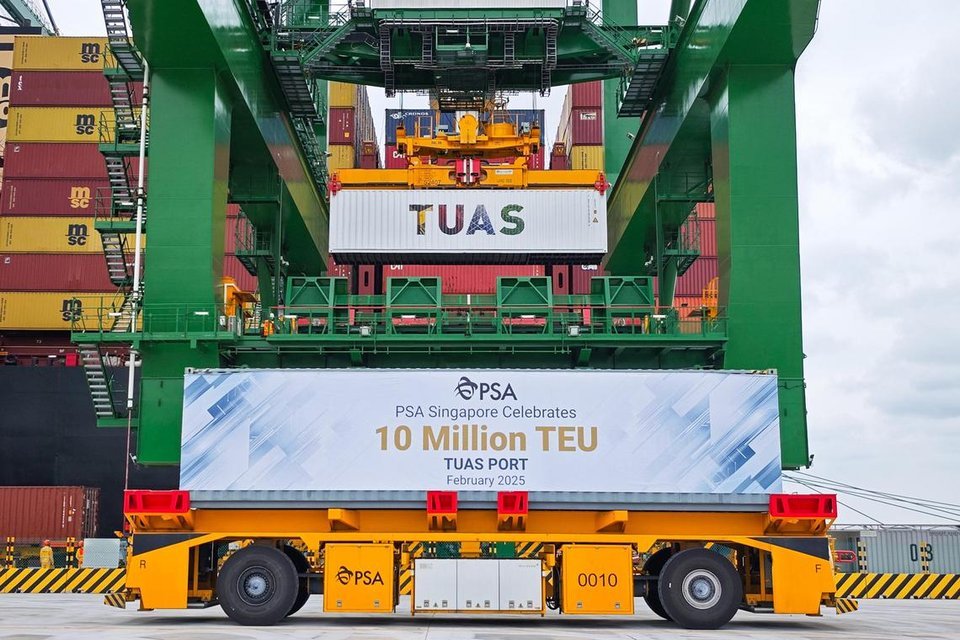
With Asia leading world trade growth, Tuas Mega Port will be increasingly pivotal in facilitating supply chain connectivity. Its capacity for the largest of vessels and smart technologies make it the hub to be for frictionless logistics. And in addition to the flow of goods, Tuas is being prepared for digital trade connectivity, with more seamless data flow between ports, and across borders. Efforts like green maritime trade routes will not just consolidate Singapore’s lead on steering the direction of sustainable logistics. Through a blend of physical capability, technological advancement and care for the environment, Tuas isn’t simply a port—it’s the blueprint for future supply chain hubs.
The conversion of Tuas into the world’s largest fully automated port is not just an infrastructure feat, it is a reimagining of how global trade can be in the decades to come. Tuas consolidates scale, technology and sustainability within one ecosystem to elevate Singapore’s position as a global maritime hub and enhance regional supply chain linkages across Asia.
In the process, it shores up the resilience of global trade routes, boosts the region’s economic growth and establishes Singapore as a reliable big tentpole in an increasingly unstable world. TUAS MEGA PORT- Walk boldly into the future As supplychain networks are reconfigured around the world, Tuas Mega Port will play its part as the focal point of that evolution, the new vanguard of Asia and beyond.